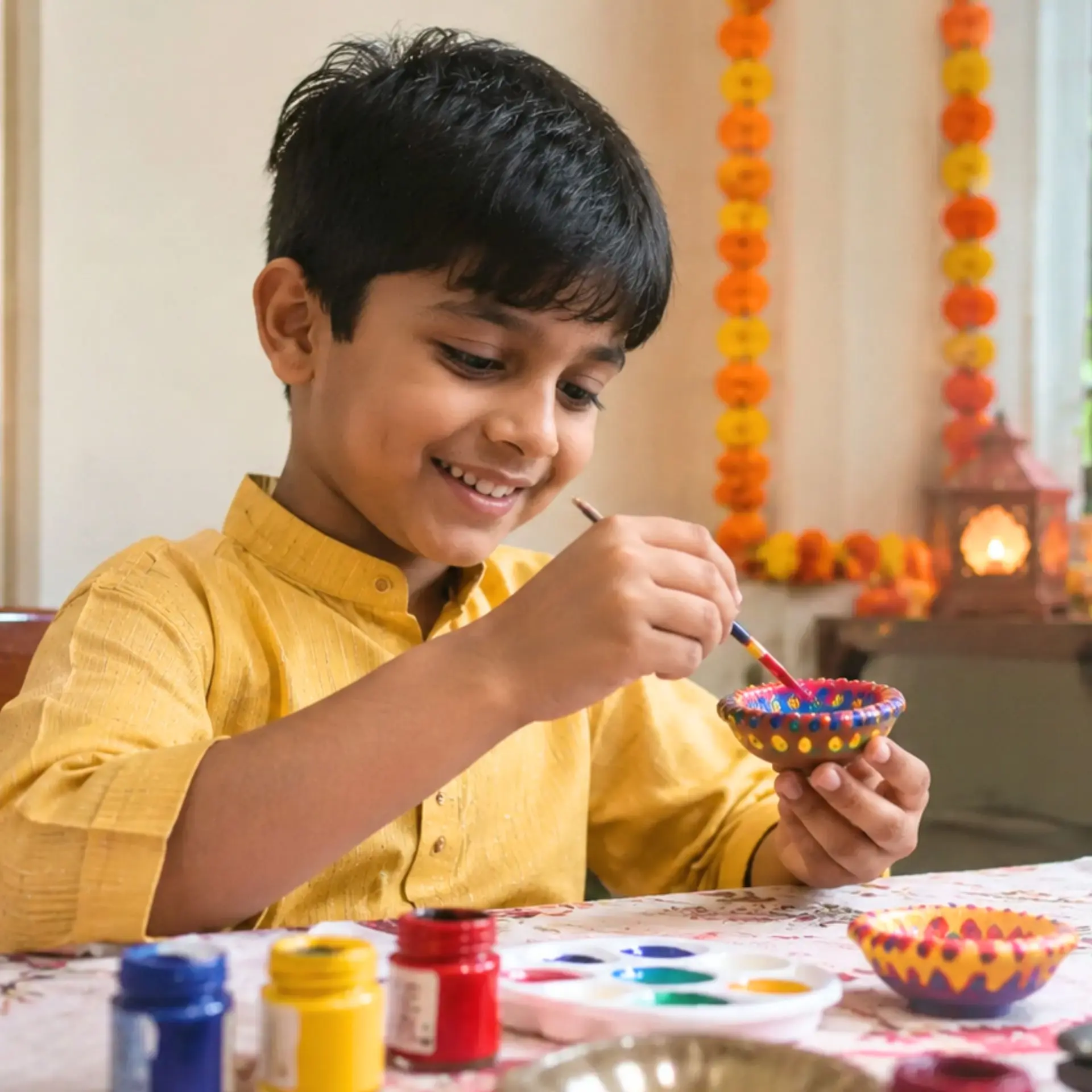
The Diwali vacation is one of the most anticipated breaks of the school year. For children, it means a welcome pause from regular classes, homework and early mornings. For parents, however, it can also bring the familiar question: “What will they do all day?”
The answer does not have to be more screen time or a tightly planned schedule. The Diwali holidays can be an opportunity for children to slow down, spend time with family, explore their creativity and learn through everyday experiences.
With a few simple activities, parents can make the Diwali vacation enjoyable while still keeping children curious, active and engaged.
1. Make Your Own Diwali Decorations
Diwali is naturally suited to creative activities.
Instead of buying every decoration, encourage children to make some themselves. Paper lanterns, greeting cards, simple wall decorations, rangoli designs and reusable festive crafts can all become hands-on projects.
Younger children can focus on colouring, cutting and arranging. Older children can experiment with patterns, materials and their own designs.
The goal is not perfection. It is to give children the opportunity to imagine something and turn that idea into something tangible.
Learning Can Be Part of the Celebration
2. Try a Family Rangoli Challenge
Rangoli can become more than a festive decoration.
Give each family member a small area or a sheet of paper and create different designs. Children can experiment with symmetry, geometric shapes, patterns and colour combinations.
For younger children, parents can introduce simple shapes and counting. Older children can explore rotational symmetry, tessellations or traditional patterns from different parts of India.
It is a simple way to combine culture, mathematics and creativity in one activity.
3. Read a Diwali Story Together
A holiday does not have to mean putting books away.
Choose a few age-appropriate stories connected to Diwali, Indian traditions or mythology and make reading part of the evening routine.
Parents can also ask children questions after the story:
- What was your favourite part?
- Which character did you understand most?
- What would you have done differently?
- What did the story teach you?
This turns reading into a conversation rather than another academic task.
4. Cook Something Together
The kitchen can become a surprisingly effective learning space.
Choose a simple festive recipe and allow children to participate in age-appropriate tasks. They can measure ingredients, count quantities, observe changes while cooking and learn how different ingredients are combined.
Older children can read the recipe independently or help calculate quantities when preparing a larger batch.
Most importantly, cooking gives families an opportunity to spend uninterrupted time together.
Early Experiences Shape Lifelong Attitudes
5. Start a Diwali Vacation Journal
A simple holiday journal can encourage children to write without making writing feel like an assignment.
Ask them to record something interesting each day or every few days:
Today I…
Something I noticed…
Something I learned…
My favourite moment was…
Children can add drawings, photographs, ticket stubs or small observations alongside their writing.
For younger children, parents can write down their words while they draw or dictate their thoughts.
By the end of the holiday, they will have a personal record of their Diwali vacation.
6. Plan a Screen-Free Family Evening
Children do not need to be entertained constantly.
Choose one evening during the holidays for a screen-free family activity. Play board games, tell stories, solve puzzles, play cards or simply talk.
Even a family walk can become an opportunity to observe the neighbourhood, discuss festive decorations or look at the night sky.
The objective is not to create another “productive” activity. Sometimes giving children space to interact, imagine and play is valuable enough.
7. Explore the Science Behind Diwali
Children naturally ask questions during festivals.
Why do diyas have flames? Why do some materials burn differently? How are colours created in rangoli? Why does oil help a lamp burn?
These questions can lead to simple, age-appropriate science conversations.
Parents do not need to turn the discussion into a formal lesson. Encourage children to make observations, ask questions and suggest explanations.
That habit of asking “why?” is itself an important part of scientific thinking.
8. Make a Family Diwali Budget
Older children can be given a small hypothetical or real budget for planning part of the celebration.
For example, ask them to decide how they would spend ₹1,000 on decorations, gifts, food or other festive requirements.
They can compare prices, add expenses and decide what is essential and what is optional.
This introduces basic financial thinking while showing children how mathematics is used in everyday life.
Parents can also discuss concepts such as saving, planning and avoiding unnecessary purchases.
9. Spend Time Outdoors
The holidays should not be spent entirely indoors.
Plan a morning walk, visit a park, play cricket, cycle where safe or organise an outdoor game with friends and family.
Physical activity is important for children’s overall health and well-being, and holiday time provides an opportunity to move without the constraints of a school timetable.
The activity does not have to be competitive. The objective is simply to keep children moving and enjoying time outdoors.
10. Give Children One Real Responsibility
Diwali preparation creates plenty of opportunities for children to contribute.
Depending on their age, they can:
- Help organise decorations
- Arrange books or toys
- Assist with simple kitchen tasks
- Prepare a shopping list
- Help set the dining table
- Keep their room organised
- Help distribute festive cards or gifts
These small responsibilities teach children that family celebrations are something everyone contributes to.
They also help build independence and confidence.
Growing Children Need Growing Responsibilities
As students move into the Secondary years, they need greater independence alongside clear expectations. Explore Secondary education at Vidyanchal High School.
11. Discover the Meaning Behind Diwali
Diwali is celebrated in different ways across India and by communities around the world.
Use the holiday as an opportunity to talk about the traditions followed by your own family and learn about how other regions celebrate.
Children can research a Diwali tradition from another part of India and present what they discover to the family.
This can introduce geography, history, culture and communication skills through a topic they already find interesting.
12. Create a “Things I Want to Learn” List
Instead of creating a holiday homework list, ask children what they would genuinely like to learn during the break.
Perhaps they want to:
- Learn a new song
- Draw a particular subject
- Learn a few words in another language
- Try photography
- Build something
- Learn a new sport
- Read a particular book
- Make a simple craft
Choose one or two ideas and give them time to explore.
A holiday can be a reminder that learning does not always begin with a syllabus.
Making the Most of the Diwali Vacation
The best Diwali vacation activities for kids do not require expensive materials, elaborate travel plans or a packed timetable.
A cardboard box can become a craft project. A family recipe can become a mathematics lesson. A story can become a conversation. A walk can become an exploration. A few hours spent helping at home can become a lesson in responsibility.
The key is balance.
Children deserve time to rest during their holidays. They also benefit from opportunities to stay active, creative and curious. Rather than trying to fill every hour, parents can create a loose rhythm that combines relaxation with meaningful experiences.
At Vidyanchal High School, learning extends beyond academics to include creativity, character development, problem-solving and experiences that help students become confident and responsible individuals.
The Diwali break is therefore not something that needs to be made “productive” at every moment. It can simply be a time for children to play, explore, create, connect and return to school refreshed.
Celebrate, Participate and Create Memories
FAQs
1. What are some fun Diwali vacation activities for kids?
Crafts, rangoli, cooking, reading, outdoor games, family games, journaling and cultural activities are simple options for different age groups.
2. How can children learn during Diwali vacation?
Children can learn naturally through cooking, budgeting, crafts, reading, conversations about traditions and hands-on projects.
3. Should children study during Diwali vacation?
Some light reading or revision may be useful, but holidays should also provide plenty of time for rest, play, family and creative activities.
4. How can I reduce screen time during the holidays?
Offer engaging alternatives such as outdoor play, board games, crafts, cooking, reading and family activities. It can also help to establish specific screen-free periods.
5. How can parents make Diwali meaningful for children?
Involve children in preparations, explain family traditions, encourage them to contribute at home and give them opportunities to create and spend time with family.