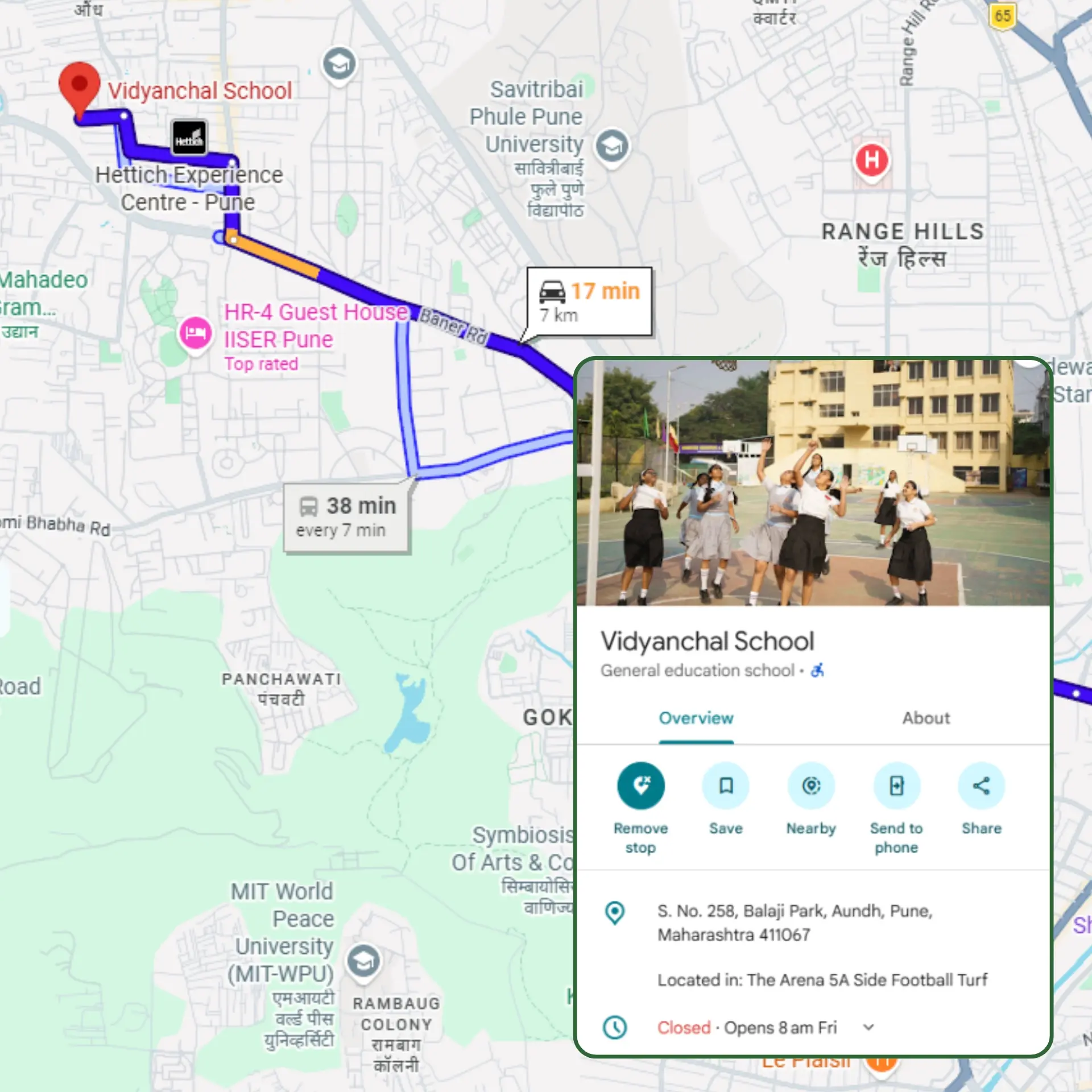
Schools near Shivajinagar are an important consideration for Pune families because accessibility affects far more than the morning commute. Where a school is located can influence how much time a child spends travelling, how early they need to wake up, how much time remains for homework and play, and how comfortably the family manages its daily routine.
For parents, choosing a school is therefore not simply about finding the right curriculum or facilities. It is also about finding a school that fits realistically into everyday life.
This becomes particularly relevant in Pune, where traffic, weather, road conditions, and peak-hour congestion can make even relatively short distances unpredictable. Recent concerns raised by parents and school transporters in Pune have highlighted issues around traffic, pedestrian safety, school-zone infrastructure, and student drop-offs during the monsoon.
At Vidyanchal High School, accessibility is one of the practical considerations that makes its Aundh-Baner location relevant for families across western and central Pune. The school is located at S. No. 258, Balaji Park, Aundh-Baner, Pune, and its location is accessible by both public transport and car.
Why School Accessibility Matters
When parents compare schools, accessibility can sometimes become an afterthought. Academic reputation, board, infrastructure, sports, and activities understandably receive more attention.
But children experience accessibility every single school day.
A manageable commute can mean:
- More time for sleep
- Less morning rushing
- More time for breakfast
- Reduced travel fatigue
- More time for homework
- Greater opportunity for sports and hobbies
- More family time in the evening
A school that works well on a map may not necessarily work well in a family’s actual daily schedule.
1. Look at the Real Commute, Not Just the Distance
A school being five or ten kilometres away does not tell the entire story.
Parents should consider:
- Morning traffic
- Afternoon traffic
- Number of junctions on the route
- Road conditions
- School-zone congestion
- Pick-up and drop-off arrangements
- Travel time during monsoon
A route that appears short outside peak hours can take considerably longer during school timings.
For this reason, parents should ideally test the journey at approximately the same time their child would actually travel.
2. Think About the Child’s Entire Day
A long commute does not only consume travel time. It takes time away from other parts of childhood.
Imagine two children finishing school at the same time.
One spends another hour travelling home.
The other reaches home significantly earlier.
The second child may have more time for:
- Lunch and rest
- Homework
- Reading
- Outdoor play
- Music or art
- Family interaction
- Adequate sleep
Research into student mobility increasingly highlights the relationship between travel time and students’ educational experience. While much of the available research focuses on older students, the underlying principle is straightforward: time spent travelling is time unavailable for other activities.
For younger children especially, protecting time for sleep, play, and family interaction is important.
3. Accessibility Can Support Better Routines
Children thrive on predictable routines.
A manageable commute makes it easier to establish consistent timings for:
Wake up → Breakfast → School → Lunch → Homework → Play → Dinner → Sleep
When travel takes up a disproportionate part of the day, routines can become compressed.
Homework may get pushed later.
Playtime may disappear.
Bedtime may become inconsistent.
The issue is therefore not simply convenience for parents. It is about protecting the child’s overall daily rhythm.
Learn more about the values and educational approach behind Vidyanchal High School.
4. Consider Sleep When Comparing Schools
Sleep is one of the most overlooked factors in school selection.
Children aged 6–12 generally require 9–12 hours of sleep per 24 hours, according to widely accepted paediatric sleep recommendations.
A school commute that requires a child to wake substantially earlier every morning can make maintaining adequate sleep more difficult.
Sleep is closely associated with children’s cognitive and behavioural development. Research reviewing preschool-age children, for example, has found that greater quantity or quality of sleep was generally associated with better cognitive and behavioural outcomes.
This makes the school commute part of a much larger question:
Does this school fit the child’s healthy daily routine?
5. Look at Transport Options
Accessibility is not necessarily about parents driving children to school every day.
Parents should investigate:
- School bus availability
- Pick-up points
- Transport routes
- Drop-off procedures
- Safety protocols
- Estimated travel times
It is also worth understanding what happens when weather or traffic disrupts normal travel.
A well-organised transport system can make school accessibility considerably easier for working parents.
Explore Pre-Primary learning at Vidyanchal High School.
6. Think About After-School Activities
This is particularly important for families who want children to participate in sports, arts, music, or other activities.
If a child reaches home late every day because of a lengthy commute, additional activities can become difficult to accommodate.
A school that combines academics with opportunities for sports, arts, events, and other activities can make the overall routine more efficient.
Instead of spending additional time travelling between different locations, children can participate in activities as part of their school experience.
7. Accessibility Is Also About Safety
Parents should evaluate the final stretch of the journey—not just the route from home.
Consider:
- Where does the vehicle stop?
- Is the school entrance clearly managed?
- Are children protected from traffic?
- Are there designated drop-off areas?
- Is there adult supervision?
- How does the school manage rainy-day arrivals?
Pune parents have specifically raised concerns about pedestrian crossings, footpaths, traffic, and school-zone safety, making these practical considerations especially relevant when visiting a school.
A school visit should therefore include a look at the entrance and surrounding roads, not just classrooms and facilities.
8. Why Aundh-Baner Accessibility Matters for Vidyanchal Families
For parents searching for schools near Shivajinagar, western Pune may still be a practical consideration depending on where they live and work.
Vidyanchal High School is located in the Aundh-Baner area, at S. No. 258, Balaji Park. The school’s official information describes the campus as accessible by both public transport and car.
Its location can therefore be relevant for families considering the broader Aundh-Baner educational corridor rather than limiting their search strictly to schools within Shivajinagar itself.
The important question remains the same:
Can the school fit comfortably into your child’s everyday routine?
9. Compare Accessibility Alongside Curriculum
Accessibility should never be the only deciding factor.
Parents should evaluate it alongside:
- Curriculum and teaching approach
- Faculty
- Student-teacher interaction
- Infrastructure
- Sports
- Arts and cultural activities
- Student well-being
- Parent-school communication
- School culture
A nearby school that does not meet your child’s educational needs may not be the right choice.
Similarly, an academically attractive school that requires an exhausting daily commute may create other challenges.
The objective is to find the right balance.
Explore Secondary education at Vidyanchal High School.
A Simple Accessibility Checklist for Parents
Before shortlisting a school, ask:
Commute
- How long does the journey take during school hours?
- Is the travel time consistent?
- What happens during peak traffic?
Transport
- Is school transport available?
- Are pick-up points convenient?
- What safety measures are followed?
Routine
- What time would my child need to wake up?
- Will there be enough time for breakfast?
- Can the child maintain an appropriate bedtime?
Activities
- Will the commute leave enough time for sports and hobbies?
- Are extracurricular activities available at school?
Safety
- Is the school entrance well managed?
- Are drop-off and pick-up areas organised?
- How does the school handle monsoon conditions?
Accessibility Is About More Than Convenience
It is tempting to think of accessibility as something that benefits parents.
In reality, the biggest beneficiary is often the child.
A manageable journey can contribute to:
- A calmer morning
- Better routine consistency
- More time for play
- More opportunities for reading
- Less travel fatigue
- Greater family interaction
The school day begins before the child reaches the classroom and continues after they leave it.
The commute is part of that experience.
Explore the events and experiences at Vidyanchal High School.
Final Thoughts
Choosing among schools near Shivajinagar should involve more than comparing academic results, fees, or infrastructure. Accessibility deserves a place on the shortlist because the school commute becomes part of a child’s everyday life.
The right school should ideally provide a strong educational environment without creating an unnecessarily exhausting daily routine.
For families considering Vidyanchal High School, its Aundh-Baner location provides another factor to evaluate alongside its academic programmes, infrastructure, sports, arts, and holistic approach to education. The school currently offers learning programmes from Pre-Primary through Secondary, supporting students across multiple stages of their school journey.
Ultimately, the best school is not necessarily the one that looks closest on a map. It is the one that fits your child’s education, routine, development, and everyday life.
FAQs
1. Why is school accessibility important for children?
A manageable commute can leave more time for sleep, homework, play, activities, and family life.
2. What should parents check during a school commute?
Check actual peak-hour travel time, traffic, transport options, drop-off arrangements, and safety around the school entrance.
3. How does a long commute affect a child’s routine?
It can reduce time available for sleep, homework, sports, hobbies, and family interaction.
4. Is Vidyanchal High School accessible from central Pune?
Vidyanchal High School is located in Aundh-Baner and is officially described as accessible by car and public transport. Parents should test the actual route from their home during school hours.
5. Should commute be the main factor when choosing a school?
No. It should be considered alongside curriculum, teaching quality, infrastructure, activities, student well-being, and the overall school environment.