School with science and computer labs is a phrase many parents search for when evaluating educational options for their children. While academic results and experienced teachers remain essential, modern education also depends on providing students with opportunities to learn by doing. Well-designed science and computer laboratories allow children to explore concepts practically, ask questions, experiment, and develop skills that textbooks alone cannot provide.
Today’s learners need more than theoretical knowledge. They need environments that encourage curiosity, innovation, collaboration, and critical thinking. Research in education consistently shows that experiential learning—where students actively participate in experiments and practical activities—improves understanding, knowledge retention, and problem-solving skills.
At Vidyanchal High School, learning extends beyond the classroom through thoughtfully designed facilities that support exploration, creativity, and conceptual understanding.
Why School Infrastructure Matters
When parents think about infrastructure, they often imagine attractive buildings or modern classrooms. While these are important, educational infrastructure is really about creating spaces where learning becomes meaningful.
Good infrastructure helps students:
- Understand concepts more clearly
- Develop practical skills
- Build confidence through hands-on learning
- Stay engaged during lessons
- Connect theory with real-world applications
According to UNESCO, quality learning environments contribute significantly to student engagement, participation, and educational outcomes. Infrastructure is not simply about appearance—it directly influences how effectively children learn.
The Importance of Science Laboratories
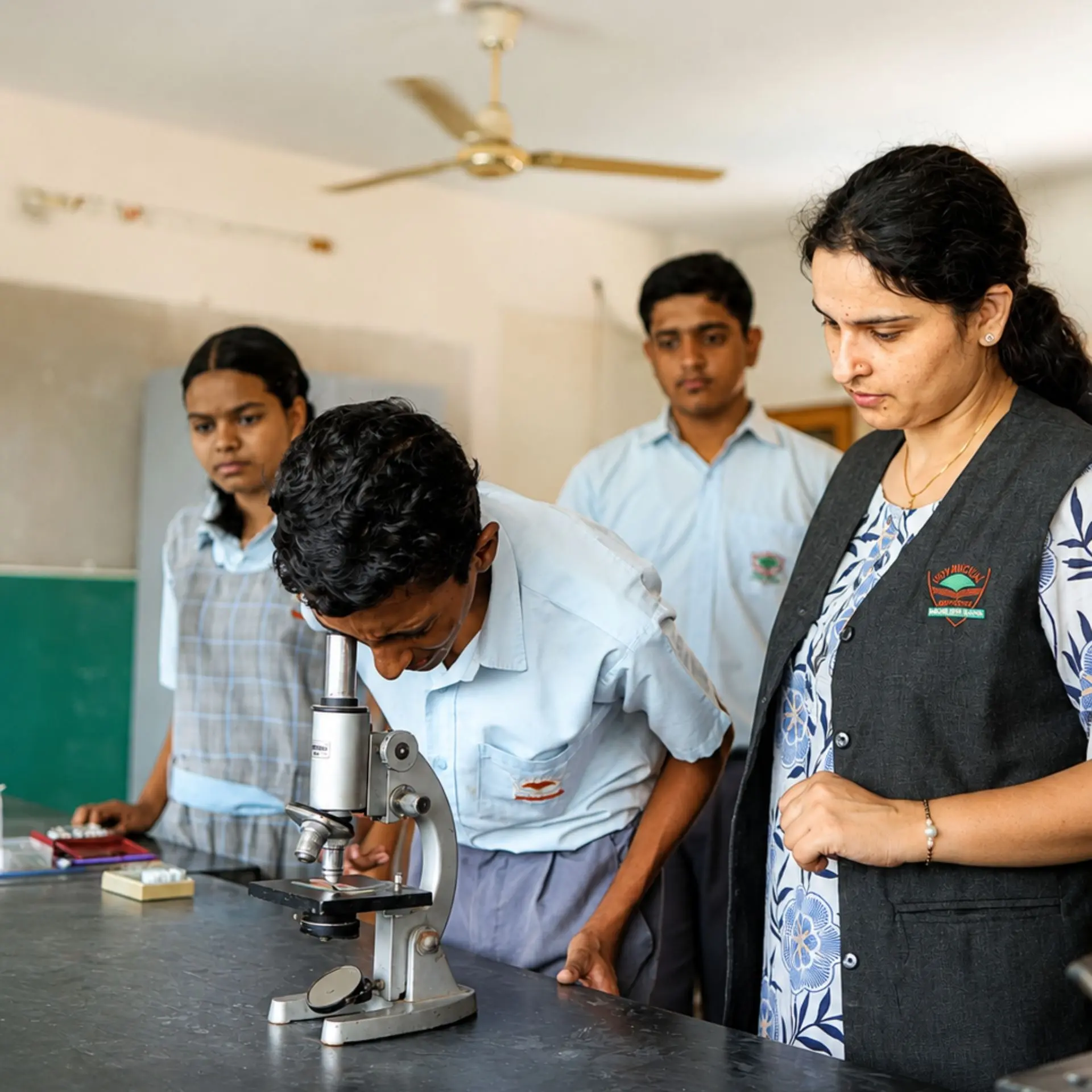
Science is best understood through observation, experimentation, and discovery.
When students perform experiments themselves, they learn to:
- Observe carefully
- Ask meaningful questions
- Record findings
- Analyse results
- Draw logical conclusions
Research in science education shows that laboratory experiences improve conceptual understanding because students actively experience scientific principles instead of only reading about them.
For example, topics such as:
- States of matter
- Electricity
- Magnetism
- Plant growth
- Chemical reactions
become easier to understand when children see them in action.
At Vidyanchal High School (VHS), science education encourages students to explore concepts practically while developing curiosity and analytical thinking.
Developing Scientific Thinking
Science laboratories teach much more than science.
Students also develop:
- Critical thinking
- Problem-solving
- Observation skills
- Logical reasoning
- Teamwork
- Patience
Educational researchers increasingly emphasise inquiry-based learning, where students investigate questions rather than memorising answers.
These skills become valuable across every subject—not just science.
Every school is guided by a philosophy that shapes meaningful learning.
Learn more about the vision and values behind Vidyanchal High School.
Why Computer Labs Are Essential Today
Technology has become part of nearly every profession.
Computer education today is not simply about learning to type.
Students use technology to:
- Research information
- Create presentations
- Solve problems
- Develop digital literacy
- Collaborate on projects
- Learn responsible technology use
The World Economic Forum identifies digital literacy among the essential skills required for future careers. Introducing these skills during school helps children become confident users of technology rather than passive consumers.
A dedicated computer lab provides a structured environment where students learn these skills under teacher guidance.
Learning Technology Responsibly
One important benefit of school computer labs is teaching children how to use technology effectively.
Students learn:
- Responsible internet behaviour
- Digital safety
- Information evaluation
- Ethical technology use
- Productive digital habits
This is particularly important today, when children are exposed to technology from a very young age.
Schools play an important role in helping students become responsible digital citizens.
Practical Learning Improves Understanding
Educational psychology consistently shows that children remember information better when they actively participate in learning.
Hands-on learning allows students to:
- Experience concepts directly
- Make mistakes safely
- Learn through experimentation
- Ask deeper questions
- Develop confidence
Instead of memorising scientific definitions, students experience scientific processes.
Instead of only reading about computers, they learn by using them.
This combination strengthens long-term understanding.
Infrastructure Supports Different Learning Styles
Every child learns differently.
Some children learn best by:
- Listening
- Watching
- Reading
- Doing
Science and computer labs support visual, kinaesthetic, and experiential learners by providing opportunities beyond traditional classroom teaching.
Children who may struggle with textbook learning often become highly engaged during practical sessions.
Building Confidence Through Experience
Children gain confidence when they successfully complete experiments, solve technical challenges, or create digital projects independently.
Practical learning teaches them:
- “I can test ideas.”
- “I can solve problems.”
- “I can learn through experience.”
These moments build confidence that extends beyond academics.
At Vidyanchal High School, practical learning experiences are designed to encourage students to become active participants in their education rather than passive learners.
Beyond Science and Computers
Good educational infrastructure works together to create a complete learning environment.
Children also benefit from:
- Well-equipped classrooms
- Libraries
- Sports facilities
- Activity spaces
- Art and cultural areas
Each space contributes differently to a child’s academic, physical, creative, and emotional development.
This holistic approach helps children discover interests beyond textbooks.
What Parents Should Look For
When visiting a school, don’t simply ask whether science and computer labs exist.
Instead, ask:
- How frequently do students use the labs?
- Are activities integrated into regular lessons?
- Are experiments age-appropriate?
- How are safety practices maintained?
- Do students actively participate or only observe?
The value of a laboratory depends on how effectively it is used for learning.
Preparing Students for the Future
The future demands more than memorisation.
Students need:
- Critical thinking
- Scientific literacy
- Digital confidence
- Creativity
- Adaptability
- Collaboration
Schools with strong practical learning environments help children develop these abilities from an early age.
At Vidyanchal High School, infrastructure is viewed not as a showcase but as a learning resource that helps students understand, question, create, and innovate.
Explore the events and student experiences at Vidyanchal High School.
Final Thoughts
Choosing a school with science and computer labs is about much more than modern facilities. It is about giving children opportunities to explore ideas, conduct experiments, develop digital skills, and connect classroom learning with real-world experiences.
At Vidyanchal High School, thoughtfully planned infrastructure supports a holistic educational experience where curiosity is encouraged, practical learning is valued, and students develop the confidence to become lifelong learners.
When children can see, touch, experiment, question, and create, learning becomes far more meaningful than simply memorising facts.
FAQs
1. Why are science laboratories important in schools?
Science labs help students understand concepts through practical experiments, improving curiosity, observation, and critical thinking.
2. What do children learn in a computer lab?
They develop digital literacy, problem-solving skills, responsible technology use, research abilities, and basic computer proficiency.
3. Does infrastructure really affect learning outcomes?
Yes. Well-designed learning spaces improve student engagement, participation, and conceptual understanding.
4. How often should students use science and computer labs?
Regular, curriculum-integrated sessions provide the greatest educational benefit by connecting theory with practical learning.
5. How does Vidyanchal High School use its science and computer labs?
Vidyanchal High School integrates practical learning into its educational approach, helping students explore scientific concepts and digital skills through guided, hands-on experiences.